
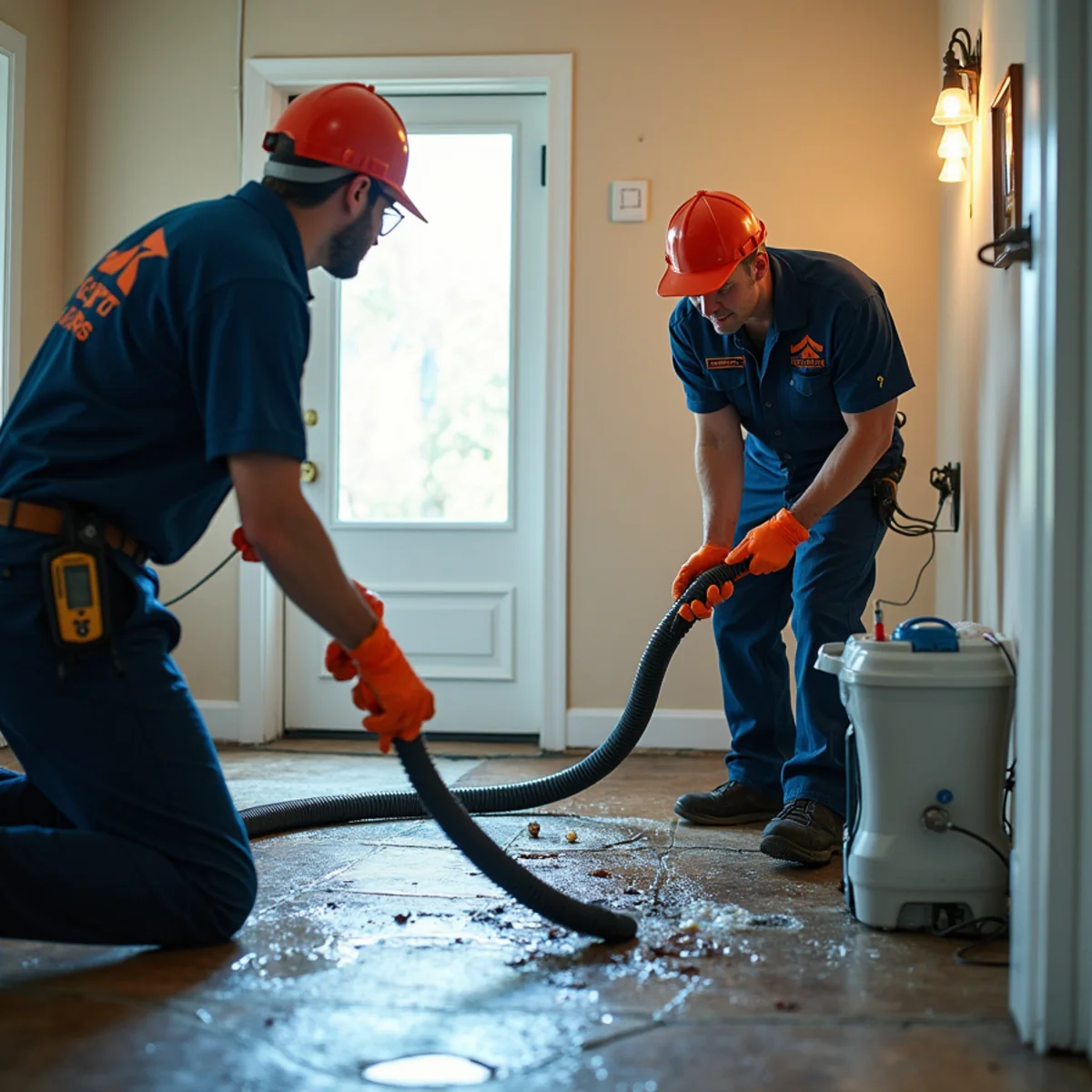
A sewer backup is a contamination event, not an ordinary mop-up. Protect people first, stop using connected fixtures, and prevent contaminated water or air from spreading into clean areas. Use the sequence below to separate immediate safety and mitigation from source repair, documentation, and later reconstruction.
Keep the area isolated
Move people and pets away, close doors when doing so will not spread contamination, and avoid walking through wastewater. Do not use household fans that could move contaminated droplets or dust into occupied rooms.
If electrical outlets, appliances, or the service system are involved, stay out and seek qualified help. Do not wade in to reach a breaker or valve.
Stop adding water to the drain system
Do not flush toilets, run sinks, or operate washing machines connected to the backed-up line. A plumber or sewer professional should diagnose and clear the cause.
A backup in a crawlspace may be out of sight but still affect insulation, soil, joists, subfloor, and indoor odor. Tell dispatch where the nearest access is and whether wastewater is still entering.
Document from a clean position
Photograph the visible boundary, source fixture or drain, affected contents, and any path into adjacent rooms. Do not handle contaminated contents just to improve the photos.
Note when the backup began, which fixtures were in use, and whether neighbors or other units experienced related problems. Those facts can help diagnose the line involved.
Understand cleanup decisions
Hard, nonporous structure may be cleaned using appropriate methods. Porous materials that absorbed sewage often require removal because contamination cannot be reliably cleaned from the full depth.
Containment, removal, cleaning, drying, and disposal should be explained as separate steps. Odor treatment is not a substitute for removing contamination.
- Source repair
- Containment
- Contaminated material removal
- Cleaning and drying
- Verification
Expert insight: turn observations into defensible decisions
Observation is not the same as diagnosis
The first clues in “Keep the area isolated” and “Stop adding water to the drain system” help set priorities, but a stain, odor, warm floor, pooled area, or policy label does not prove the complete cause or affected boundary. Confirm the source with the appropriate trade and compare visible conditions with the paths water could take through the actual assembly.
Use a scope checkpoint before work expands
Before opening a finish or changing the equipment plan, ask what new evidence supports the decision. The answer may be contamination, delamination, a trapped cavity, a material that is not drying, or access required for source repair. Record that trigger so the owner, repair trade, and insurer can understand why the scope changed.
The honest tradeoff is speed versus unnecessary disruption
Delay can allow water to spread, yet speed does not justify broad demolition or a universal equipment package. The professional balance is fast safety and source action followed by targeted extraction, access, cleaning, and monitored drying. That approach protects salvageable materials without closing wet or contaminated assemblies behind new finishes.
Decision table: match the condition to the next call
| Condition | Practical next action | Why it matters |
|---|---|---|
| Electrical, structural, fire, or sewage hazard | Keep people out and contact the qualified emergency authority or trade. | Property protection never comes before life safety or controlled access. |
| Plumbing, appliance, roof, drainage, or sewer source is active | Stop it only when safe, then assign source repair to the appropriate trade. | Mitigation cannot succeed while the cause continues to add water. |
| Surface looks dry but porous or concealed material was affected | Map the moisture path and set a material-specific drying or removal plan. | Appearance alone cannot verify subfloor, cabinet, insulation, or cavity conditions. |
| An insurance claim may be opened | Protect the property, notify the carrier, and keep a source-to-closeout record. | Clear facts reduce avoidable disputes, while coverage remains the insurer's decision. |
Related services
Use these service pages for the restoration process, estimate factors, and decisions connected to this guide.
Local area guides
These pages connect the advice to San Carlos housing and neighborhood conditions without changing the safety principles.
Frequently asked questions
When should I treat water damage as an emergency?
Treat it as urgent when water is still flowing, electricity may be involved, a ceiling is sagging, sewage is present, or water is moving into additional rooms or levels.
Can I clean a small sewage spill myself?
Contaminated water can create exposure and cross-contamination risks. Avoid contact and obtain a professional assessment when wastewater reaches porous finishes, multiple rooms, HVAC paths, or a crawlspace.
What is the biggest mistake to avoid when following this sewage backup: immediate safety steps guide?
Do not start aggressive cleanup, demolition, or equipment use before checking electrical, structural, and contamination hazards and controlling the source when it is safe. Record the initial condition first, then make each scope decision from observed material condition and moisture evidence.
What should I document before the next restoration step?
Keep wide and close photos, the discovery and shutoff timeline, source-repair records, affected-room notes, moisture readings, equipment or drying logs, scope changes, contents records, receipts, and insurer communications. Documentation supports clarity but never guarantees coverage.
Conclusion: make the next decision evidence-led
The practical answer behind “Sewage Backup: Immediate Safety Steps” is to work in order: protect people, control the source, document the starting condition, define the affected boundary, remove water or contamination, verify drying, and only then plan finished repairs. That order keeps an urgent loss from becoming an unstructured sequence of overlapping promises.
If the event is small, clean, and completely accessible, safe owner action may be enough. If water is moving through building materials, involves sewage or electricity, threatens a ceiling or floor, or cannot be traced confidently, step back and request a property-specific inspection. Ask every provider to explain the evidence, scope trigger, trade boundary, estimate assumption, and closeout record.